Thursday, 30 August 2012

Maddy Deegan, Picture Books

The Viewer, author Gary Crew, illustrator Shaun Tan
The viewer tells the story of time through a picture ‘viewer’; the illustrations follow the historical moments in history. The viewer has a dark and supernatural like nature and allows the reader to develop their own interpretations and understanding of what happens to the lead character Tristan at the end of the story.


The Red Tree. Author and illustrator Shaun Tan
This is one of my favourite books as I feel like it has captured the issue of depression in a way that allows adolescents to feel comfortable about approaching the topic with embarrassment of judgement. Like many of Shaun Tan’s books the narrative focus is visual with very few words, but this in itself demonstrates the books brilliance. Tan has captured an extremely complex topic and developed it so the reader can relate and feel comforted through a sense of understanding.

In class discussion summary 31.08.12

Our class discussion focused on the readings and glossary terms that where set as a workshop task. As a group we focused on why it is important for students to know the meaning of words and their relationship within a text. We touched on the fact that although some of the glossary terms are not as prevalent within primary classroom situations they play a major role in teacher understanding and knowledge and also are an important aspect when focussing on children with speech impediments.
Throughout our in class discussion we spoke about understanding persuasive and informative texts and the power of words in their ability to be able to convince the reader of something. The understanding of the two types of texts is imperative for students as they can then develop an understanding of the power of words and develop the knowledge of how not to be manipulated.  
A large portion of our discussion also looked at the concept of grading text and finding engaging texts that are at the students reading level but also provide interest and enjoyment. The development of reading levels and students ability is imperative but similarly allowing students to choose and explore different texts allows for an enjoyable and engaging learning experience.

Wednesday, 29 August 2012

Petrina's Fifth Reading Log Entry


Jackie French’s min-world in Somewhere around the Corner is drawn in a manner that appears to powerfully portray life in the make-shift shanty towns around Sydney during the Great Depression.  Her twist in the plot that links a street protest in the 1990s with one in 1932 is a clever tool to draw the reader from a contemporary (almost) to a tumultuous era in Australian history.  A common thread is woven between the introduction and conclusion … but I won’t spoil the surprise!
The mini-worlds in Paul Jennings’ Unreal short stories are, by contrast, a quirky blend of rather unusual … often weird and containing behaviours that may be considered ‘naughty’… plots, settings and characters, merged with experiences that children would be very familiar with.  E.g. Fear of giving talks in front of the class, bullies, family tensions.  The first-person narrative is written in language akin to that spoken by children, and would be easy for them to identify with.  The stories may be useful to make books more attractive to the reluctant reader.

'Mr McGee and the Biting Flea' & 'The Twits'


'Mr McGee and the Biting Flea' by Pamela Allen
This book took me back...one of my favourites in primary school. The words, although quite simple, are really rhythmic, which makes it really fun to read, especially out loud. Definitely a book for the younger students, but a great one for introducing poetry and rhyme, with a focus on repetitive language. The pictures tell the same story as the text and create a lasting visual impact. A fun book to read in the classroom!


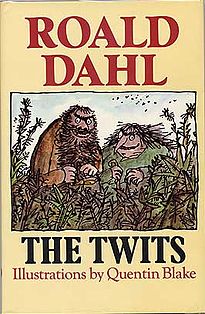
'The Twits' by Roald Dahl (illustrated by Quentin Blake)

A Roald Dahl book has to make at least one appearance and this one is definitely a classic! The thing that I really like about this book is the fact that the two main characters are evil, horrible people. But they do get what's coming to them at the end and Dahl sets this up so well with the descriptive language he uses, that the reader is against the Twits from the start. The illustrations capture the grotesque characters in all their glory (or lack of), which also helps to make this book memorable.


Tuesday, 28 August 2012

Madeleine Deegan, Picture Books Post 3


Hairy Maclary, author/illustrator Lynley Dodd

Hairy Maclary is a children’s book that uses descriptive and imaginative words in  a rhyme sequence that allows the reader to get a full understanding of the characters and their personality and appearance. The use of rhyme throughout this book is simple yet effective allowing younger students to grasp the initial notion of a complex topic.

images.jpg


Slinky Malinki, author/illustrator Lynley Dodd

Slinky Malinki is similar to that of Hairy Maclary in that it uses many adjectives to paint the picture of the characters. Slinky Malinki follows the story of a cat who is a thief by night, stealing from the people around the neighborhood. The rhythmic pattern of the book is enjoyable to read and listen to making it an all time favorite for all. 

slinky-book.jpg


Madeleine Deegan, Picture Books


Mr. Bear and The Bear, author Frances Thomas, illustrator Ruth Brown

This story deals with the issues of animal cruelty and the life of a secluded man who finds a friend in a dancing bear. Mr. Bear’s realization that the bear is not being treated respectfully and his endeavor to save him and restore him to his original life highlights the care and love that is not recognized initially in Mr. Bear’s character. The illustrations that are in this book are not only descriptive but allow the reader to get a sense of the animal cruelty that exists with circus animals.

mr_bear_and_the_bear_cover.jpg


The Whales Song, author Dylan Sheldon, illustrator Gary Blythe

The whale’s song is a story of hope and belief. It focuses on a young girl and the stories that she is told by her grandpa and grandmother about whales and the beauty and practicality that they hold. The differing opinions of her grandparents is extreme, as one focuses on the food and whaling aspect of their existence while the other focuses on the beauty of their ‘song’. Leaving Lily to her own means in order to appreciate their beauty and develop her own opinion. 

AB076-2T.jpg


Wednesday, 22 August 2012

Reading Log 4

Daddy's Little Scout, written by Janet Bingham and illustrated by Rosalind Beardshaw is a picturebook about moving and finding a new home. 
Little Fox and his Dad are visiting the animals of the forest to see their homes.  They go to see  Mrs. Finch who is building a new nest, the rabbits are making new rabbit holes and Mr. Mole is digging new tunnels to live in.  Little Fox is outgrowing their den, and the Foxes will need a new home.  So little Fox and his Dad go to seek a new place for them to live. 

This is an adorable picturebook which is very well suited to a bedtime story. It should be noted that this is a companion book to 'Mummy's Little Star' also by Janet Bingham.


The second reading I have chosen is actually a short story out of Shaun Tan's 'Tales from Outter Suburbia'.  A very strange complilation of fiftheen short stories, out of these I have chosen 'Undertow'  a story very simply about a dugong that appears on the front lawn of a otherwise quite suburban street on very strange morning.  While all the surrounding neighbours are trying to do something about this very strange situation, the owners at number seventeen are somewhat disconnected from the whole situation and are more concerned with the markings the dugong has left on their lawn!